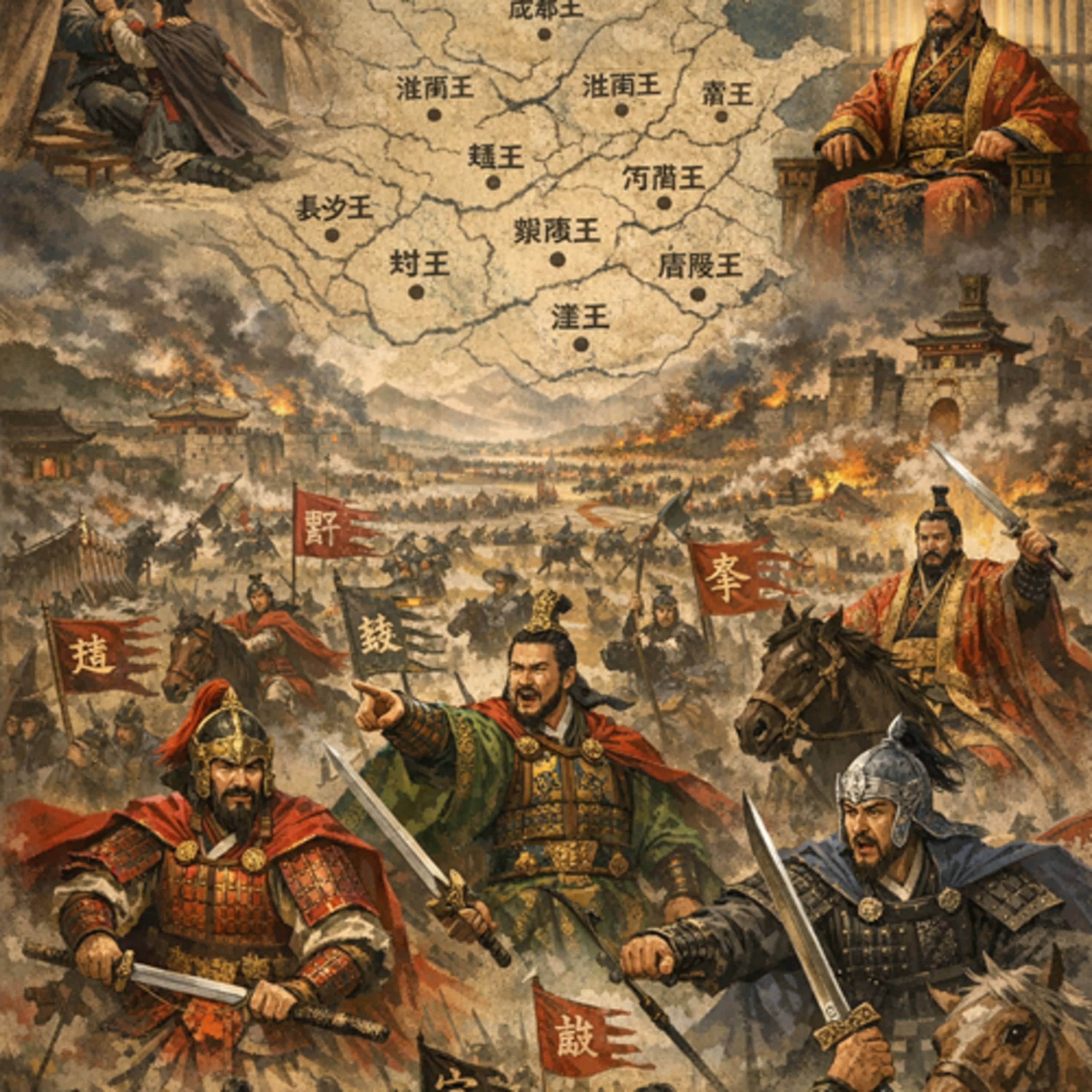
The War of the Thirteen Princes: How Royal Infighting Destroyed the Western Jin Dynasty
Reviewing Chinese history with systems analysis2026-01-1300:29:19
The War of the Thirteen Princes during the early Jin Dynasty illustrates the dangers of concentrated power without proper checks and balances. Among the thirty royal princes granted territories, Thirteen became especially powerful. However, they were not properly appointed officials but rather royal family members competing for supremacy—a characteristic flaw of autocratic systems where ultimate power enables anyone to do whatever they want, no matter how brutal or ridiculous.
This conflict stemmed from decisions made during the dynasty's founding. When Emperor Yuan of Jin (司馬睿) moved the capital south across the Yangtze River to establish the Eastern Jin, it marked a critical turning point. The establishment of the Jin Dynasty itself was built on the foundation laid by Sima Yi (司馬懿) and his descendants.
Sima Yi, though highly educated and from a distinguished family, initially lacked strong military control compared to predecessors like Cao Cao. His political success depended heavily on support from his younger brother, Sima Fu (司馬孚)—often considered the true gentleman of pure reputation during that era. Without Sima Fu's support, Sima Yi could never have achieved political dominance, nor could his sons Sima Shi and Sima Zhao have eventually seized power.
When Sima Yan (司馬炎) became emperor and founded the Jin Dynasty, he faced a dilemma: how to reward supporters and pacify the realm. He granted enormous territories to his uncles and cousins—in some cases, more land than to his own brothers. This created an unsustainable power structure where royal family members controlled vast military and territorial resources.
The tragic irony is that the Jin Dynasty fell into the same trap that allowed them to replace the Cao family: most Cao family members lacked military authority, but the Sima family granted it freely to relatives. Empress Jia Nanfeng's seizure of power and subsequent execution of rival princes triggered a cascade of rebellions among these lord-kings. For nearly three decades, self-proclaimed claimants fought one another while emperors changed rapidly. This internal conflict, confined entirely within the royal family, eventually weakened the dynasty so severely that when the capital moved south under Emperor Yuan, they could only control territories south of the Yangtze River, surrounded by minority ethnic groups in the north.
This period demonstrates why republican democracy, electoral systems, and balance of power matter—concepts that may seem difficult to imagine from the perspective of people seventeen hundred years ago, yet their absence led to precisely this kind of destructive chaos.
Support this show: https://ckeiik73n1k6i08391xamn9ho.firstory.io/join
Leave a comment and share your thoughts: https://open.firstory.me/user/ckeiik73n1k6i08391xamn9ho/comments


