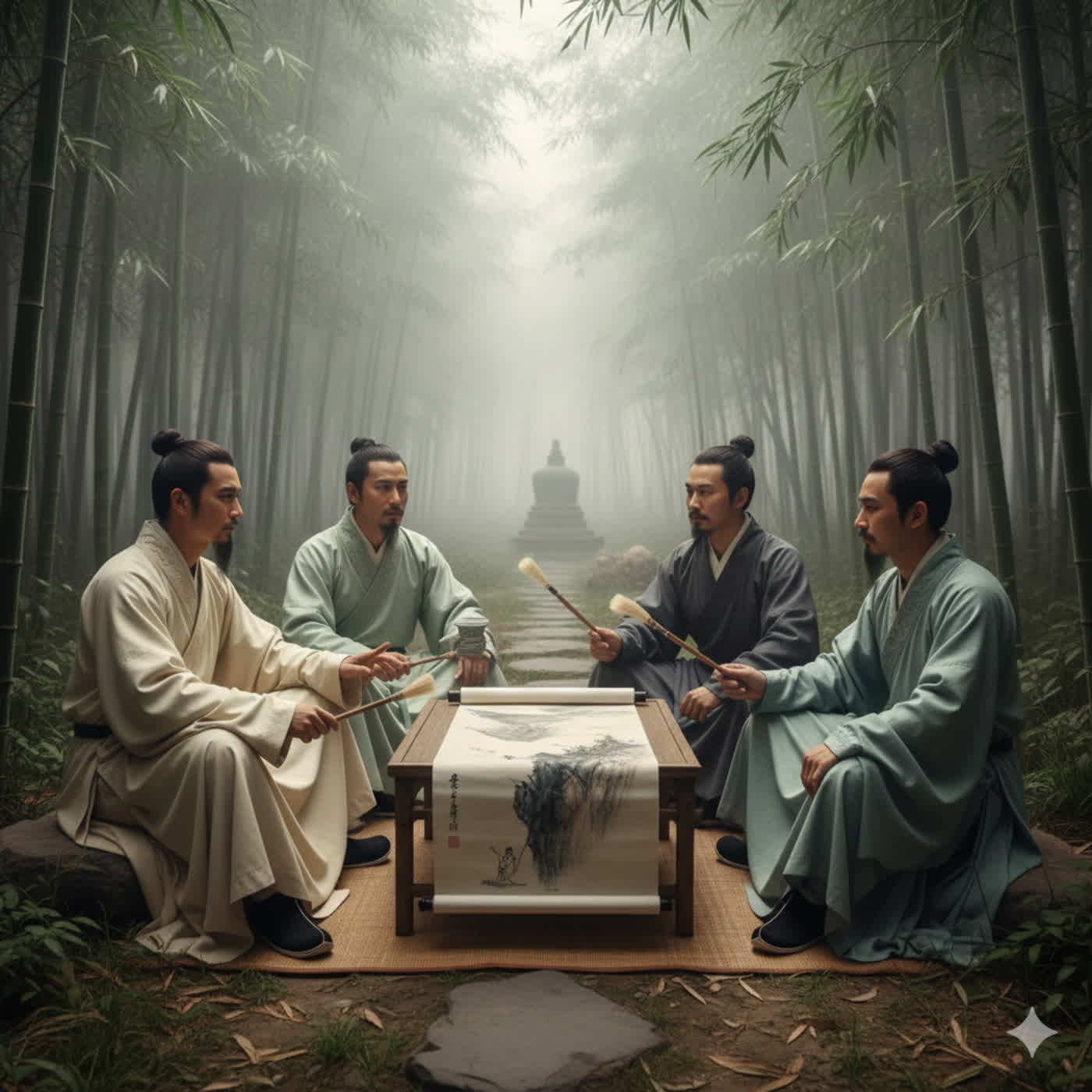
Blood, Silk, and the "Great Emptiness": The Brutal Realism of China’s Middle Ages
Reviewing Chinese history with systems analysis2026-02-2300:33:34
What happens when a civilization's moral compass (Confucianism) snaps, and the only thing left standing is the sharp edge of a general’s sword?
In Volume 16 of the Bo Yang Edition of Zizhi Tongjian, titled sarcastically "The Day the Imperial Army Recaptured the North," we uncover a 400-year cycle of chaos that transformed the Chinese DNA forever. Here are the three pillars of that transformation:
1. The "Honorable" Lie: Liu Yu and the Birth of the Usurper
The title of this era is a masterpiece of irony. General Liu Yu claimed he was "unifying the North" to restore the glory of the Han people. But as Bo Yang reveals, this wasn't a mission of liberation—it was a PR campaign for a coup.
The Reality: Liu Yu used the prestige of military victory to silence his critics in the South. On the very day the "Imperial Army" supposedly won, the Eastern Jin Emperor was being forced to abdicate.
The Lesson: If you have a dream, you must be the one in charge of it. If you let someone else "help" you achieve your vision, you aren't the leader—you're just their stepping stone.
2. The Great Mental Escape: From Rituals to Xuanxue
With the North in constant flux and the South trapped in a "Veto-Government" (where elite families held more power than the Emperor), society broke.
The Death of Logic: Confucianism—a philosophy of order—fails when there is no order. As Hegel noted, it became a "book of tactics" rather than a philosophy.
The Birth of the "New Thought": People turned inward. By blending Taoism (nature), Buddhism (the afterlife/emptiness), and Confucianism (social mask), they created Xuanxue (玄學).
Cultural Explosion: This wasn't just "talk." It birthed a colorful, diverse, and "impure" art scene. Cave paintings and Buddhist grottoes became the only places where the common man could find a "peace" that the warlords couldn't steal.
3. "Might is Right": The 400-Year Warlord Shadow
The era of the Wei, Jin, Southern, and Northern Dynasties (221–589 AD) taught China a cold lesson: Words don't matter; military strength does.
The General-Emperor Model: From Liu Yu to the founders of the Sui and Tang Dynasties, every successful leader was a warlord first. Even the Tang royal family (the Li and Yang families) were intermarried military elites from the Northwest.
The Cycle of Violence: This "Might is Right" mentality created a 700-year shadow (extending through the Five Dynasties) where every prince needed his own private army just to survive.
The Final Fix: It wasn't until the Song Dynasty that a founder (Zhao Kuangyin) finally realized the system was broken and "restricted the power of the generals" to stop the cycle of blood.
The Bottom Line
This period reminds us that when politics become a "mess," the elite hide in philosophy while the strong take the throne. It was a time of Merritocracy's decline and the General’s rise.
Which part of this cycle do you see repeating in history? The rise of the "Hero-Usurper" or the retreat of the intellectuals into "Pure Talk"?


