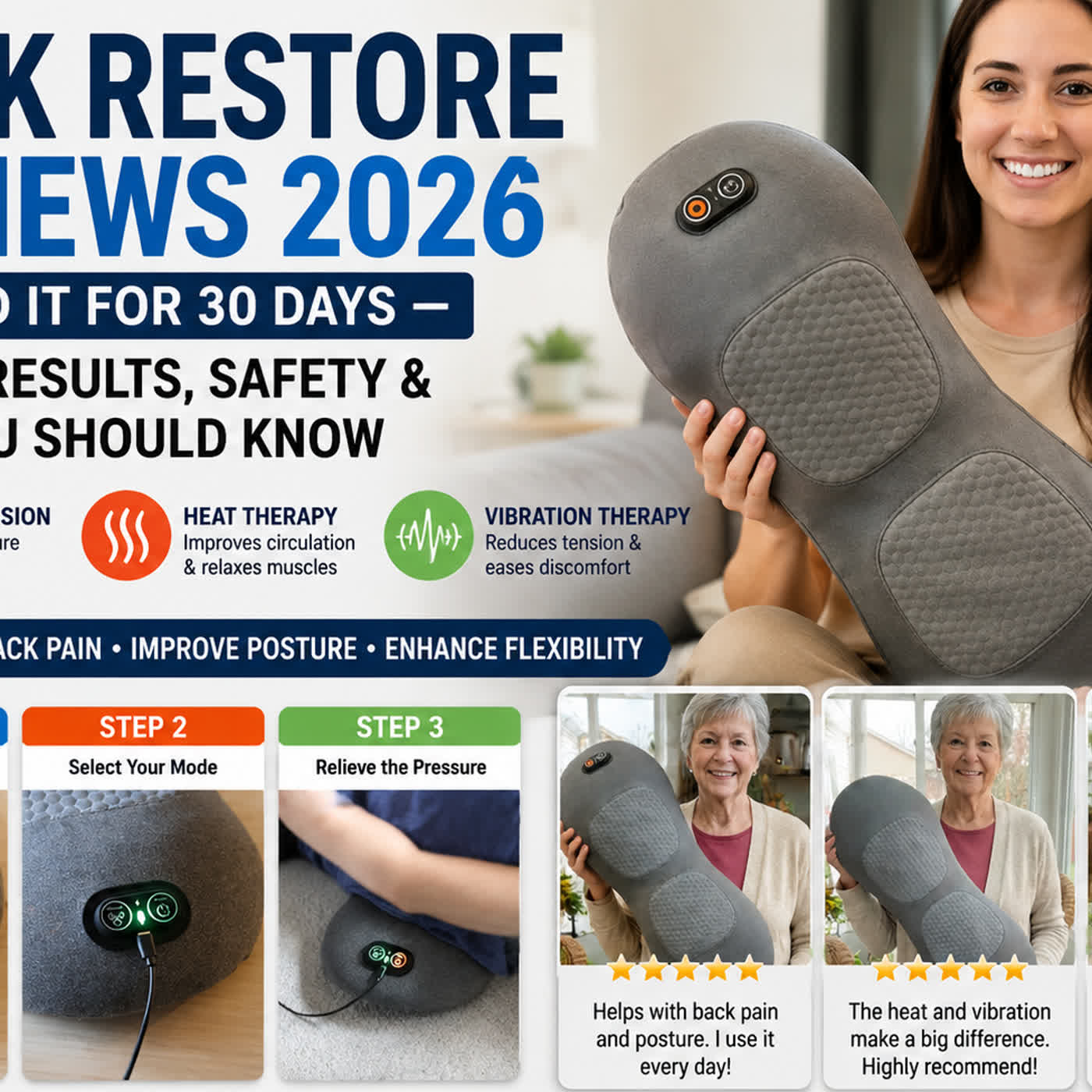
If you have spent any portion of your adult life dealing with that nagging, deep-seated ache in your lower back, you probably know the specific type of desperation that leads you to the 2 AM Google search. You’ve seen the ads, you’ve read the glowing testimonials that sound a little too perfect, and you’ve likely scrolled through a dozen Back Restore reviews that leave you more confused than when you started.
I’ve been there. My "back story" (pun intended) involved three years of "tech-slump" from my home office, a failed attempt at becoming a marathon runner, and a collection of foam rollers that now serve as expensive cat toys in my guest room. I was skeptical. Actually, "skeptical" is an understatement—I was cynical.
I’ve seen the gadgets that look like plastic wedges promising to fix years of structural damage in five minutes. When I first encountered the Back Restore and its "Regenesis Tri-Therapy" claims, I assumed it was just another iteration of the same old story. But after three months of consistent use and a deep dive into the mechanics of axial traction, I realized that I needed to share a more balanced perspective. This isn’t a marketing pitch. It’s an honest account of what it actually feels like to use this device, where it genuinely helps, and where you need to manage your expectations.
The primary reason I didn't immediately dismiss Back Restore was the combination of its three core technologies. Most at-home back tools are one-trick ponies. They either provide a static stretch, a bit of heat, or a vibrating massage.
The logic behind the Back Restore Regenesis system is something I actually discussed with my physical therapist years ago. In a clinical setting, they use decompression tables that cost as much as a luxury sedan. The reason they work is that they offload the spine. However, the biggest barrier to at-home stretching is "muscle guarding." When your back hurts, your muscles tighten up to protect the area. If you try to stretch a "guarded" muscle, it fights back, and you get nowhere.
Back Restore uses heat and vibration specifically to "distract" the nervous system and relax the muscle fibers before and during the traction process. It’s a sophisticated approach to a very old problem. I wanted to see if a device that costs less than a single specialized clinic visit could actually replicate that biological sequence.
Are you looking to verify if the 2026 inventory is currently in stock? Before you read further, it’s a smart move to check the official source for the most up-to-date pricing and regional availability.
👉 Check the official Back Restore website for today’s special offers.
When the Back Restore arrived, my first concern was build quality. If I’m going to lay my entire body weight on a device, I don’t want it to feel like cheap, hollow plastic.
I was pleasantly surprised. The device has a significant "heft" to it. The curved ergonomic structure is wrapped in high-density foam that has enough "give" to be comfortable but remains firm enough to maintain the necessary leverage for decompression. It feels like a piece of recovery equipment, not a toy.
The setup was refreshingly simple. In an age where everything requires a 2.4GHz Wi-Fi connection and a firmware update, the Back Restore is remarkably analog in its ease of use. You plug it in, choose your level, and lie down. There was no "friction" to starting my first session, which is usually the first hurdle to habit-building.
To understand the value of this device, we have to look past the surface level. This is where most people get confused: they think they are just lying on a humped surface. In reality, there are three distinct biological mechanisms happening simultaneously.
This is the heavy hitter. Every hour you spend upright, gravity is winning. Your vertebrae are being squeezed together, which forces the fluid out of your spinal discs—the shock absorbers of your body. Back Restore uses your own body weight and its specific curvature to create a gentle "pulling" sensation. This creates what scientists call "negative pressure," which helps encourage blood flow and nutrients to seep back into the discs.
The heat function isn't just for comfort. By applying consistent, controlled warmth to the lumbar fascia, the device encourages vasodilation. This widening of the blood vessels is critical because it brings oxygen-rich blood to the area, helping to flush out metabolic waste and prepare the muscles for the stretch.
This is perhaps the most underrated part of the system. The high-frequency vibration helps to "dampen" pain signals being sent to the brain. If you’ve ever bumped your elbow and instinctively rubbed it to make it stop hurting, you’ve used this principle (The Gate Control Theory). The vibration keeps the muscles from tensing up, allowing the traction to go deeper than a standard floor stretch ever could.
I didn't want to write this review after one use. I wanted to see if the "miracle" would wear off. Here is the realistic timeline of my first month.
Week 1: The "Good Hurt" Phase Let’s be honest—if your back is tight, the first few sessions might feel intense. It’s a productive discomfort. Your spine is being asked to go into a position it hasn't inhabited in years. I found that I could only manage 5 minutes at a time for the first three days.
Week 2: The Morning Shift By the middle of the second week, I noticed a change in my "morning mobility." Usually, it takes me a cup of coffee and a hot shower to feel like I can move normally. After using Back Restore for 10 minutes before bed the night before, I started waking up feeling significantly less "glued together."
Week 4: Functional Wins This is where the skepticism really started to die. I noticed I could sit at my desk for a full two-hour deep-work session without the burning sensation in my lower back that usually kicks in at the 45-minute mark. My posture had subtly shifted; I was less inclined to "slump" because my lower back felt supported rather than fragile.
👉 View official Back Restore details and the latest 2026 pricing here.
I have to be clear about the downsides. No device is a magic wand, and the Back Restore has its boundaries.
It requires floor time: While you can use it on a firm mattress, it is 50% more effective on a yoga mat on the floor. If you have extreme mobility issues and cannot get down to or up from the floor, this device might be a challenge for you to use independently.
The "Alignment" Learning Curve: This is where most people get frustrated. If you don't place the device correctly in the small of your back, it just feels like a hard lump. It took me about four sessions to find my "sweet spot" where I could actually feel the vertebrae offloading.
It is not a "Cure": If you have a severe structural condition that requires surgical intervention, a $90 device is not going to change that. It is a support and maintenance tool designed for mechanical tension, postural stress, and mild-to-moderate disc compression.
In 2026, a single session with a high-end chiropractor or a manual therapist can easily run you $100 to $160 out of pocket.
The Back Restore typically retails for around $89.97. Even if you only use it twice a week for a year, your "per-session" cost drops to under a dollar. From a purely financial perspective, the value is astronomical. But beyond the dollars, there is the value of autonomy. There is something incredibly empowering about being able to address your own physical discomfort at 11 PM on a Sunday night without having to wait for an appointment or drive across town.
Based on my research and hands-on testing, the Back Restore feels legitimate because it adheres to the basic principles of physical therapy. It isn't trying to "realign" your spine with a single crack; it is trying to rehydrate and decompress your discs through gentle, consistent traction.
The "hype" usually comes from the marketing that promises it will fix everything for everyone. It won't. But for the 80% of us who suffer from posture-induced compression, it is one of the most effective at-home tools I’ve ever evaluated.
👉 Check the current availability of the Back Restore at the official store.
What I Loved (The Pros):
The Tri-Therapy Approach: The heat and vibration make the stretch feel earned and safe, rather than forced.
Drug-Free Relief: I’ve been able to significantly cut down on my use of over-the-counter anti-inflammatories.
Portability: It’s light enough that I actually took it on a week-long road trip to help with "driver’s back."
Risk-Free Trial: The 90-day money-back guarantee is a massive trust signal. They aren't afraid of you using it for three months.
What I Didn't Love (The Cons):
AC Power Dependency: You need to be near an outlet to use the heat and vibration. I’d love to see a cordless version in the future.
Firmness: It is firm. If you are expecting a "pillow" sensation, you will be disappointed. It is a therapeutic tool, not a lounge accessory.
Initial Intensity: As mentioned, those first few days can be a hurdle for people who aren't used to deep stretching.
Buy it if:
You spend more than 5 hours a day sitting at a desk or in a car.
You wake up with a "stiff" back that takes forever to loosen up.
You are looking for a conservative, non-invasive way to manage mild disc issues.
You value having a "Plan B" for your back health at home.
Skip it if:
You have a history of unstable fractures or osteoporosis.
You are looking for a replacement for professional medical advice for a severe, diagnosed injury.
You are unwilling to commit to at least 10 minutes of consistent daily use.
Your spine is the foundation of your movement. If you’re tired of living around your back pain, finding the right support can be life-changing.
👉 Claim your 2026 Back Restore discount and start your 90-day trial today.
1. Is Back Restore safe to use every single day?
Yes. In fact, the device is specifically designed for a daily 10-15 minute "reset." Like staying hydrated or brushing your teeth, the benefits of spinal decompression are cumulative. Short daily sessions are far more effective than one long session once a week.
2. Can I use Back Restore if I've had previous back surgery?
This is a critical "Let’s be honest" moment: You should never use a traction or decompression device after spinal surgery without the explicit approval of your surgeon. While many people use it for post-recovery maintenance, your specific hardware and fusion status matter immensely.
3. Does it help with sciatica or shooting leg pain?
Sciatica is often caused by a disc pressing on the sciatic nerve. By gently stretching the vertebrae apart and creating more space, many users (including myself) report a reduction in that "pins and needles" sensation. However, everyone’s nerve pathway is different.
4. Is the traction level adjustable?
Most Back Restore reviews mention this—the device relies on your positioning. You can adjust the "intensity" by how you place your legs (bending your knees reduces the stretch, straightening them increases it). This allows you to start gently and "level up" as your flexibility improves.
5. How long does a typical session last?
The "sweet spot" is 10 to 15 minutes. The vibration and heat functions are timed to provide maximum muscle relaxation in that window. You don't need to spend an hour on it to see results.
6. What if I don't feel anything happening? This usually comes down to alignment. Try shifting the device an inch higher or lower until you feel that "unloading" sensation. Remember, this is a gentle process; you shouldn't feel like you’re on a medieval rack. You’re looking for a subtle release.
7. Is there a weight limit for the device?
The 2026 reinforced model of Back Restore is designed to handle most adult body types up to approximately 300 lbs. If you have concerns about the structural support for your specific frame, checking the detailed specs on the official site is recommended.
Taking care of your back in the modern world is a marathon, not a sprint. We live in an environment that is biologically "hostile" to our spines—too much sitting, too much leaning, and too much static pressure.
The Back Restore isn't a miracle cure, but it is one of the most practical, high-value additions to a home wellness routine I have seen in my ten-plus years of evaluating products. It bridges the gap between doing nothing and paying for expensive, ongoing clinical treatments.
If you are realistic about the effort—knowing that you need to use it consistently and start slow—this device offers a profound sense of relief. It is about taking the "pressure off," literally and figuratively, so you can get back to living your life without your back being the main character of your day.
Final Thought: If you have $90 and ten minutes a day, your future self will likely thank you for choosing the path of proactive recovery.