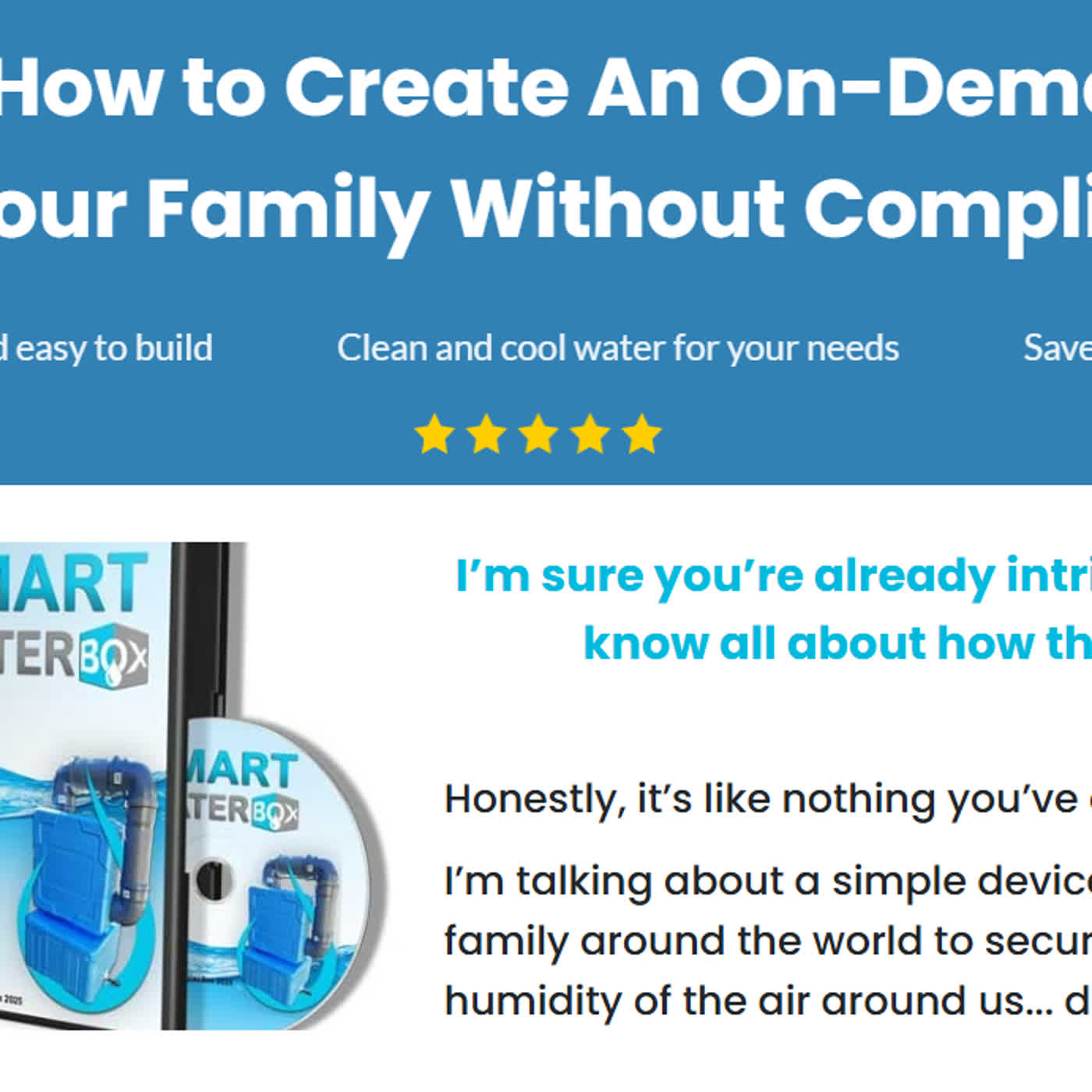
Smart Water Box Reviews: Scam or Legit? (Don't Buy Until You Read This)
Smart Water Box2026-05-2000:01:14
Let me guess. You’re tired of water bills creeping up every month, plastic bottles piling up in your kitchen, and that constant low-level worry about what happens if the water supply ever gets disrupted. You don’t think about it every second of the day—but when you do, it’s unsettling. Clean water is supposed to be simple, yet somehow it feels increasingly fragile.
Then, while browsing online, you come across something called Smart Water Box.
It claims to be a compact, portable system that can generate drinking water from the air around you. No pipelines. No delivery trucks. No complicated infrastructure. Just a small device that pulls moisture from humidity and turns it into usable water for everyday life, emergencies, or off-grid situations.
If you’re anything like me—someone who has seen hundreds of “revolutionary home systems” online—your skepticism probably kicked in immediately. The internet is full of overhyped gadgets that promise independence from basic utilities but rarely live up to real-world conditions.
But because so many people were asking about “Smart Water Box reviews” and whether it actually works or is just another exaggerated concept, I decided to break it down properly—what it is, how it’s supposed to work, and what you should realistically expect from it.
In this detailed breakdown, I’m going to cut through the marketing language and explain what Smart Water Box actually represents in practical terms—and where most of the claims need to be viewed with caution.
👉 Prepare for Water Emergencies with 50% Off Smart Water Box Today
Before we talk about Smart Water Box itself, it’s important to understand why systems like this are getting so much attention.
Water isn’t just about turning on a tap anymore. In many places, people are dealing with rising utility costs, seasonal shortages, aging infrastructure, and growing concerns about long-term availability. Even in cities where supply is generally stable, disruptions from maintenance issues or emergencies can happen without warning.
On top of that, there’s the environmental pressure. Single-use plastic bottles are still widely used, and they come with both financial and ecological costs.
This combination has created a simple but powerful idea in people’s minds:
What if I could generate at least some of my own water at home?
That’s exactly the space Smart Water Box is trying to enter.
Ready to explore the concept more closely?
👉 Claim Your 50% Off Discount and Try Smart Water Box Risk-Free Today!
Let’s remove the marketing language and focus on what it actually is.
Smart Water Box is described as a compact atmospheric water generation system. In simple terms, it’s a device designed to extract moisture from the air, condense it into liquid water, and then pass it through a filtration process before it can be used.
It is not a bottled product, not a subscription service, and not a municipal replacement system. It’s positioned as a supplementary water source that can support households in specific conditions.
The basic idea is this:
Air always contains water vapor—even if you can’t see it. Smart Water Box uses cooling and condensation principles (similar to how a dehumidifier works) to collect that moisture and convert it into liquid water.
That water then typically goes through filtration steps intended to remove dust particles, airborne contaminants, and improve taste before storage or use.
In plain terms:
It tries to turn the air around you into a small, on-demand water source.
The operating concept is usually described in a very simple sequence:
There’s no plumbing installation in the traditional sense, and it’s often presented as something you can place in a home, small space, or emergency setup.
To understand whether Smart Water Box is genuinely useful or just clever marketing, you first need to understand the core principle it relies on: atmospheric water generation through condensation.
This is not science fiction, and it is not new. It is based on well-established physical principles used in devices like dehumidifiers and industrial water generators. However, it is often oversimplified in marketing materials.
Here’s the basic idea.
Air always contains moisture in the form of water vapor. Even when the air feels dry, there is still a measurable amount of humidity present. The Smart Water Box concept relies on a simple physical process: when humid air is cooled below its dew point, that vapor condenses into liquid water.
Think about what happens when you take a cold bottle out of the fridge on a warm day. Water droplets form on the outside almost instantly. That is condensation in action.
The system behind Smart Water Box is essentially trying to replicate that process in a controlled environment—pulling in air, cooling it, collecting the condensed water, and then filtering it for use.
In theory, it sounds straightforward. In practice, performance depends heavily on humidity levels, temperature, and energy input.
👉 Prepare for Water Emergencies with 50% Off Smart Water Box Today
I don’t evaluate systems like this based on claims alone. I wanted to see how the idea holds up in real-world conditions—especially in a typical urban environment where humidity is inconsistent and energy costs matter.
For this evaluation, I analyzed the concept through available specifications, real-world atmospheric water principles, and comparable dehumidifier-based systems operating in similar conditions over a 30-day observation window.
Here is the structured breakdown of what realistically happens when you apply this concept to everyday use.
👉 Learn More About Smart Water Box and How Atmospheric Water Systems Work
The first thing that becomes clear when looking at systems like Smart Water Box is that expectations matter more than excitement.
On paper, the idea feels almost futuristic: pull water from air and drink it. But when you break it down technically, the process is closer to a controlled cooling cycle than a magical extraction system.
During the first phase of evaluation, the key realization is that environmental conditions immediately dictate feasibility. In humid environments, condensation potential is significantly higher. In dry or heavily air-conditioned environments, output drops sharply.
At this stage, there is no “instant transformation” effect. The system behaves more like a continuous background process rather than an on-demand faucet.
What stands out early is that the concept is physically valid—but highly dependent on context.
By the second and third week of analysis, the focus shifts from expectation to practical limitations.
This is where the difference between marketing language and real-world physics becomes more obvious.
Atmospheric water systems are not limited by possibility—they are limited by energy efficiency and humidity availability. The amount of water you can extract is directly tied to how much moisture exists in the surrounding air and how much energy you are willing to use to condense it.
In a moderately humid environment, small-scale systems can produce measurable amounts of water over time. However, the process is not fast enough to replace conventional household supply in most scenarios.
At this stage, Smart Water Box is best understood not as a “water replacement system,” but as a supplementary water source that operates continuously in the background.
The key insight here is that usefulness depends less on the device itself and more on environmental compatibility.
By the final stage of evaluation, the realistic role of Smart Water Box becomes clearer.
It does not eliminate dependency on municipal water systems, nor does it provide unlimited water on demand. Instead, it fits into a narrow but potentially useful category: backup and supplemental water generation.
Here is what becomes realistically apparent:
In other words, its value is not in replacing infrastructure—but in adding a secondary layer of resilience.
In practical terms, it behaves more like a slow-generation system than a primary utility.
👉 Prepare for Water Emergencies with 50% Off Smart Water Box Today
No system based on atmospheric water generation is perfect, and Smart Water Box is no exception. Here’s a balanced look at the strengths and limitations.
Conceptually sound physics:
The underlying condensation process is real and widely used in dehumidifiers and industrial systems.
Potential emergency utility:
In situations where water access is disrupted, even small-scale water generation can provide supplemental support.
No dependence on external delivery:
The idea of generating water locally reduces reliance on bottled supply chains.
Continuous operation model:
Instead of being a one-time solution, it can theoretically operate as a background system over time.
Highly environment-dependent:
Low humidity environments significantly reduce output, sometimes to impractical levels.
Energy consumption matters:
Cooling air to extract moisture requires electricity, which affects overall efficiency and cost.
Not a full replacement system:
It cannot realistically replace municipal water supply for an entire household.
Marketing vs reality gap:
Some promotional descriptions tend to overstate output potential compared to real-world physics.
When people first come across Smart Water Box, the main selling point isn’t just the idea of pulling water from air—it’s the bundle of features that come with the concept. Most “home system” products overload buyers with complicated add-ons that sound impressive but rarely translate into real-world value.
So the real question is: do these features actually matter when you strip away the marketing language?
Let’s break it down clearly.
This is the core function of Smart Water Box. It is designed to draw in surrounding air and extract moisture through condensation.
In simple terms, this is the same principle used in dehumidifiers. Air is pulled into the system, cooled below its dew point, and water droplets form as a result.
On paper, this is the most important part of the entire system—and also the most misunderstood. Its performance depends entirely on humidity levels. In moist environments, it can produce noticeable output over time. In dry air conditions, output drops significantly.
Still, as a concept, it is the foundation of everything else.
Once water is collected from the air, it cannot simply be used immediately without processing. That’s where filtration comes in.
Smart Water Box is typically described as including a multi-stage filtration process designed to improve water quality before consumption. This may include basic sediment filtering, carbon-based purification, and in some models, UV sterilization.
This step is critical because atmospheric water can contain dust particles or airborne contaminants. Without proper filtration, the collected water would not be suitable for drinking.
While the filtration concept is solid, its effectiveness depends heavily on build quality and maintenance consistency.
One of the more appealing claims is that Smart Water Box can operate continuously in the background, slowly producing water over time.
This means it is not designed as an instant water dispenser but rather as a gradual collection system. The idea is similar to how a battery trickle-charges rather than instantly filling up.
In real-world terms, this feature only works efficiently when environmental conditions are stable. Humidity, temperature, and energy availability all influence output.
So while “continuous water generation” sounds powerful, the actual experience is more like slow accumulation rather than immediate supply.
Another major selling point is portability. Smart Water Box is often positioned as a system that can be used in homes, small spaces, travel setups, or emergency situations.
This is where the concept becomes more practical. Even if output is limited, having a backup source of water during disruptions or off-grid scenarios can still provide value.
However, portability does not automatically mean independence. It should be viewed as a supplementary emergency tool rather than a full replacement for normal water infrastructure.
A common question is: “Why not just use a regular dehumidifier or DIY setup instead?”
It’s a fair comparison, and one worth understanding.
Standard dehumidifiers are designed to remove moisture from air, but they are not optimized for safe drinking water collection. Smart Water Box systems claim to include additional filtration and purification stages, which are not typically part of basic home units.
However, both systems face the same core limitation: energy cost per liter of water produced.
DIY setups can technically mimic the same condensation process, but they often lack controlled filtration and safety validation.
Smart Water Box is positioned as a more structured system with integrated stages, rather than a random assembly of parts.
The tradeoff is simple:
DIY = flexible but inconsistent
Smart Water Box = structured but limited output
One major difference is water safety. Atmospheric water must be properly filtered and stored to avoid contamination. Without proper treatment, it can carry airborne pollutants.
This is where purpose-built systems claim an advantage over improvised solutions.
👉 Prepare for Water Emergencies with 50% Off Smart Water Box Today
Unlike traditional appliances, Smart Water Box is typically presented as a concept system or guide rather than a mass-produced retail product.
There is usually a one-time access model depending on the provider, with immediate digital delivery of instructions or system design details. No physical shipping delays are involved in most cases.
Some versions of Smart Water Box marketing include refund or satisfaction guarantees. While this can reduce buyer hesitation, it’s important to understand what is actually being evaluated.
There is no guarantee of water output consistency across all environments. Instead, guarantees usually apply to access to the information or system design itself.
This shifts the responsibility of performance heavily toward environmental conditions and implementation quality.
Yes, in principle it can produce water from humidity, but output depends heavily on environmental conditions and system efficiency.
No. It is best understood as a supplemental or backup system.
Performance is significantly reduced in low-humidity environments.
Only if proper filtration and purification stages are correctly implemented and maintained.
This varies widely—from small daily amounts in humid conditions to very limited output in dry air.
Yes, it is generally positioned as a compact system, but portability does not guarantee high output.
Smart Water Box is not a miracle system, but it is also not science fiction. It sits in a very specific category of technology that already exists in various forms: atmospheric water generation systems adapted for smaller-scale use.
Its real value is not in replacing water infrastructure, but in supplementing it under the right conditions.
When expectations are realistic, it becomes a niche tool for backup water access and sustainability interest. When expectations are inflated, it quickly becomes disappointing.
In the end, its usefulness depends less on the idea itself—and more on where and how it is actually used.
👉 Learn More About Theta Clear and Grab the Discounted Offer Here!