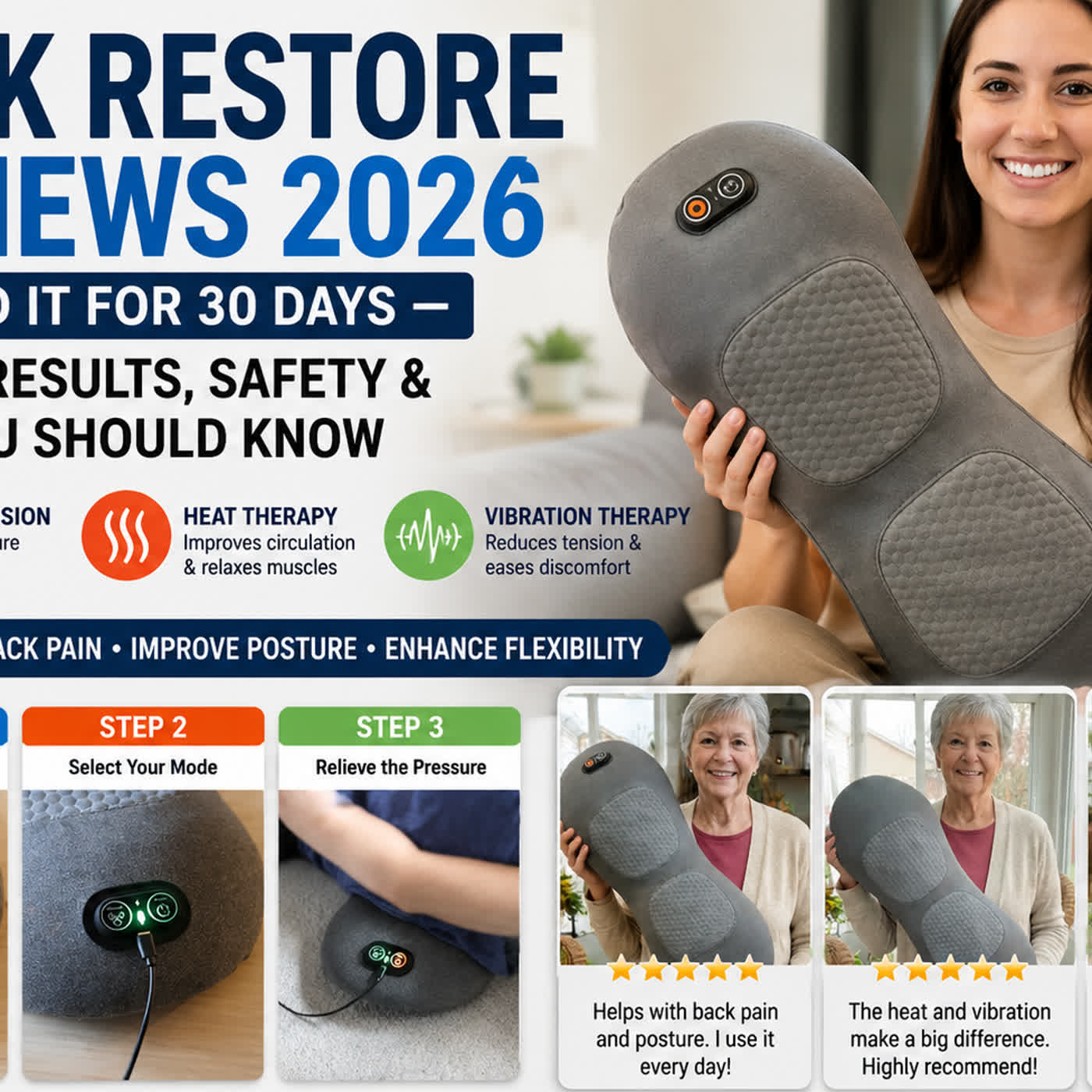
Back Restore Review: My Honest Experience After 90 Days (Pros, Cons & Results) Last Updated: May 22, 2026 If you have spent any portion of your adult life dealing with that persistent, deep-seated ache in your lower back, you already know the kind of desperation that leads to a 2 AM internet search. You have seen the ads, skimmed the glowing testimonials that sound a little too polished, and scrolled through reviews that leave you more confused than when you started. I have been there. My back story involves three years of postural damage from a home office setup, a short-lived attempt at distance running, and a collection of foam rollers that now serve as expensive cat toys. I was not just skeptical — I was cynical. So when I first came across the Back Restore and its three-part therapy claims, I assumed it was another overpriced wedge of plastic. Three months of consistent use and a deeper look at the mechanics of spinal decompression changed my perspective. This is not a marketing piece. It is an honest account of what this device actually does, where it falls short, and who it is genuinely built for. Why This Device Was Worth a Second Look Most at-home back tools are one-trick tools. They either provide a passive stretch, a bit of warmth, or a vibrating cushion. The Back Restore attempts something more deliberate: a three-part biological sequence that mirrors what physical therapists do in clinical decompression therapy. The key problem with stretching a painful back is something called muscle guarding. When your back hurts, the surrounding muscles contract involuntarily to protect the area. Trying to stretch a guarded muscle is largely futile — it fights back. The logic of this device is to use heat and vibration to relax those muscles first, and only then allow the traction to do its work. It is not novel science. It is simply a clinical approach that has, until now, been locked behind equipment that costs as much as a luxury car. Check the official Back Restore website for current pricing and availability. How the Three-Part System Actually Works Dynamic Traction Decompression Every hour you spend sitting or standing, gravity is slowly compressing your spinal discs — the fluid-filled shock absorbers between your vertebrae. The device uses your own body weight against a carefully engineered curve to create what researchers call negative intradiscal pressure. This gentle pulling sensation encourages nutrient-rich fluid to seep back into the discs, which is something a standard floor stretch rarely achieves. Thermal Support The heat function is not simply there for comfort. Controlled warmth causes vasodilation — a widening of the blood vessels — which draws oxygen-rich blood into the lumbar region and helps flush out the metabolic waste products that accumulate around chronically tense muscles. It is active preparation for the stretch, not a bonus feature. Neuromuscular Vibration This is the most underappreciated part of the system. High-frequency vibration works on the same neurological principle as rubbing a bumped elbow: it temporarily dampens the pain signals traveling to your brain, a well-documented phenomenon known as the Gate Control Theory. With those signals quieted, muscles stop guarding, and the traction can reach a depth that no static stretch on its own can replicate. A Realistic 30-Day Timeline Week One — The Productive Discomfort Phase If your back is chronically tight, the first few sessions will feel intense. Your spine is being asked to decompress into a position it has not inhabited in years. I could only manage five minutes at a time for the first three days. This is normal and expected. Week Two — The Morning Shift By the midpoint of the second week, I noticed a meaningful change in my morning mobility. I had always needed coffee and a hot shower before I could move without stiffness. After using the device for ten minutes before bed, I began waking up noticeably less rigid. That small shift in how a day begins is not insignificant. Week Four — Functional Wins This is where my skepticism genuinely began to dissolve. I found I could sit at my desk through a full two-hour work session without the familiar burning sensation in my lower back that had previously arrived around the 45-minute mark. My posture shifted subtly. I stopped slumping because my lower back felt supported rather than fragile. What It Does Not Do — Honest Limitations It requires floor use. The device works best on a firm surface like a yoga mat. If you have significant mobility limitations that make getting down to and up from the floor difficult, independent use may be a challenge. There is an alignment learning curve. If the device is not placed correctly in the curve of your lower back, it simply feels like a hard lump. It took me roughly four sessions to find the position where I could actually feel the vertebrae decompressing. Most people give up before they get there. It is not a cure. If you have a severe structural condition requiring surgical intervention, no device at this price point will change that. Back Restore is a tool for mechanical tension, postural compression, and mild-to-moderate disc issues — not a replacement for medical care. The Value Case A single session with a quality chiropractor or manual therapist in 2026 runs between $100 and $160 out of pocket. The Back Restore retails for around $89.97. Used twice a week over a year, the cost per session drops to well under a dollar. Beyond the finances, there is something genuinely valuable about being able to address back discomfort at 11 PM on a Sunday without waiting for an appointment. Visit the official Back Restore store to review the current offer and 90-day trial terms. Pros and Cons — The Unvarnished Breakdown What works well: The tri-therapy approach is its strongest asset. The heat and vibration make the decompression feel earned and safe rather than forced. Regular use allowed me to significantly reduce my reliance on over-the-counter anti-inflammatories. The device is light enough that I took it on a week-long road trip. The 90-day money-back guarantee is a genuine trust signal — the company is not afraid of you actually using it. What falls short: It requires a power outlet, so the heat and vibration functions are not available everywhere. It is firm — noticeably so. If you are expecting something that feels like a cushion, you will be disappointed. It is a therapeutic tool, and it feels like one. The first week of sessions can also be a real barrier for people unaccustomed to deep spinal stretching. Who Should Buy This — and Who Should Skip It It is a strong fit if you spend more than five hours a day sitting at a desk or in a car, you wake up stiff most mornings, you are looking for a non-invasive way to manage postural tension or mild disc compression, or you want a reliable home option between professional appointments. Skip it if you have a history of unstable fractures or osteoporosis, you are managing a severe diagnosed spinal condition that requires professional oversight, or you are not willing to commit to at least ten minutes of consistent daily use. Inconsistency will produce no results. Frequently Asked Questions Is it safe to use every day? Yes. The device is specifically designed for a daily ten-to-fifteen-minute session. The benefits of spinal decompression are cumulative — short daily use outperforms occasional long sessions by a significant margin. Can I use it after back surgery? Not without explicit clearance from your surgeon. While many people use it for post-recovery maintenance, the specifics of your hardware and fusion status matter enormously. Do not assume. Does it help with sciatica? Sciatica is often caused by a disc pressing on the sciatic nerve. By gently creating more space between the vertebrae, many users report a reduction in the characteristic radiating or tingling sensation. Results vary depending on the individual nerve pathway and the degree of compression. How do I adjust the intensity? Positioning controls the depth of the stretch. Bending your knees reduces the traction; straightening your legs increases it. This allows you to start gently and progress as your flexibility improves over time. The Final Assessment Taking care of your back in the modern world is a long game. We live in an environment that is structurally hostile to the spine — too much sitting, too much forward lean, too much sustained compression. The Back Restore is not a miracle device. But it is one of the most practical and well-reasoned additions to a home wellness routine I have encountered. It bridges the gap between doing nothing and paying for ongoing clinical treatment. If you approach it with realistic expectations — starting slowly, using it consistently, and understanding its limitations — it delivers a meaningful and lasting sense of relief. Your back is the foundation of almost every movement you make. A device that costs less than a single clinic visit and gives you genuine autonomy over your own recovery is, in this writer's assessment, worth taking seriously. Start your 90-day risk-free trial at the official Back Restore website today.